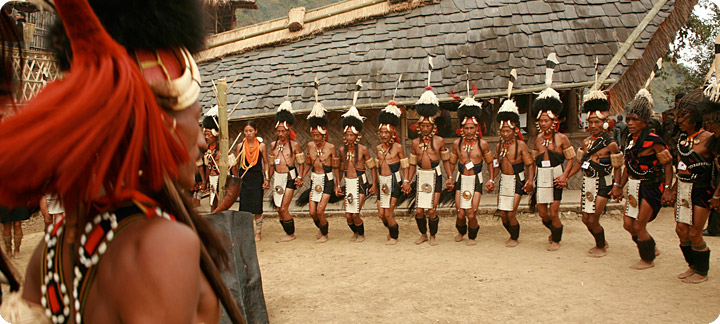
In the extreme eastern and fag end of Himalayas, The Seven Sister States are a region in northeastern India, comprising the contiguous states of Arunachal Pradesh, Assam, Meghalaya, Manipur, Mizoram, Nagaland, and Tripura. The sisters lie deep in the lap of easternmost Himalayan hills in north-eastern part of India. Connected to rest of India by merely 20 km of wide land (at Siliguri, West Bengal), the North-East India shares over 2,000 km of border with Bhutan, China, Myanmar and Bangladesh. When India became independent from the United Kingdom in 1947, only three states covered the area. Manipur and Tripura were princely states, while a much larger Assam Province was under direct British rule. four new states were carved out of the original territory of Assam. Assam is the gateway through which the sister states are connected to the mainland. The people of the region are a mixture of Aryan and Mongoloid origin, most of the tribal groups racial origins being visibly those of the peoples of Tibet, Burma, Thailand and Laos. They consequently have little in common with the rest of India. The region is known for its unique culture, handicrafts, martial arts, and scenic beauty. The North-East India is home to varied number of tribal groups (almost 166). Each tribe has their own distinct culture, which gives them a unique cultural identity. Numerous of art forms and festivals of the region are intrinsic part of its rich culture and tradition. Many of festivals like Bihu, Jhum Cultivation, Ke Pemblang, Nongkrem, Durga Puja and Karchi Puja are some of the most important festivals, which are mirror to rich socio-cultural life of North-East India. Main industries in the region are tea-based, crude oil and natural gas, silk, bamboo and handicrafts. The states are heavily forested and have plentiful rainfall. There are beautiful wildlife sanctuaries, tea-estates and mighty rivers like Brahmaputra. The region is also home to one-horned rhinoceros.
There are few regions in Indian Himalayas infact the whole of India which are beautiful and mystical as the seven sister states region. Known to very few, this is a treasure trove of history, culture and natural surroundings. A treat to eyes, ears, it slowly but firmly ensconces itself in your soul. Whether it is one horned rhinoceros, Vaishnavite monasteries in the largest inhabited riverine island in the world, deep unexplored gorges, colonial bungalows in the midst of tea gardens that have still maintained their charm, local dance forms, staying in a house on stilts, visting Mongoloid tribe of Mishmis, expanse of the Lohit and Brahmaputra Rivers, visiting National parks or even visiting a museum in the first oil town of South Asia. Each experience brings its own flavor that you are unlikely to forget any time soon.